
Urinalysis and Parasitology
Urinalysis and Parasitology Department at Dr. Daneshbod Laboratory in Shiraz
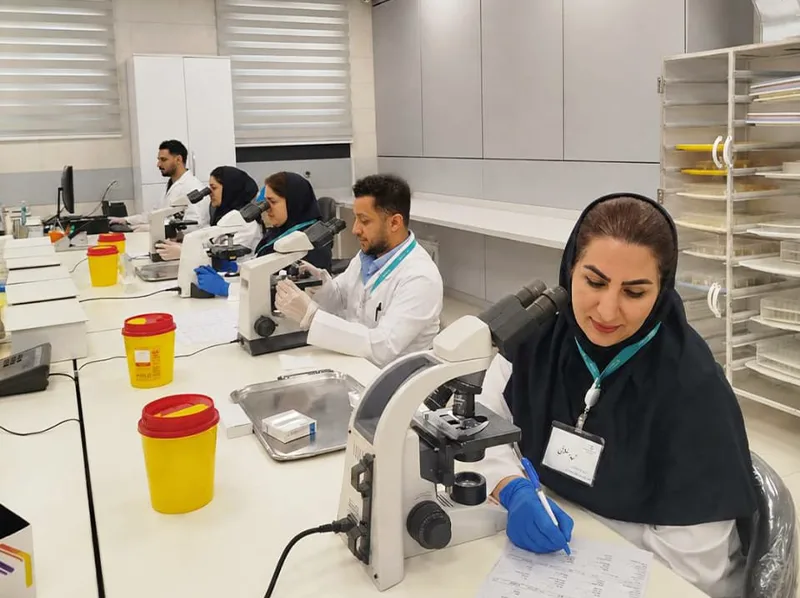
The Urinalysis and Parasitology Department at Dr. Daneshbod Pathobiology Laboratory in Shiraz performs laboratory evaluation of urine and stool specimens to assess a range of urinary, renal, metabolic, and parasitological findings.
In the urinalysis section, the physical and chemical characteristics of urine are evaluated together with microscopic findings. In the parasitology section, stool specimens are examined, based on the physician’s request, for laboratory evidence of certain intestinal parasites.
For both types of testing, specimen quality, proper collection technique, and timely transport to the laboratory are important. Contamination or improper collection and storage may affect test results.
What Is a Complete Urinalysis (Urinalysis or U/A)?
A complete urinalysis (U/A) is a common laboratory test that can provide preliminary information about the urinary tract, kidney function, and certain metabolic conditions.
A routine urinalysis generally consists of three main components:
Physical Examination of Urine
During the physical examination, characteristics such as the following may be assessed:
Urine color
Clarity or turbidity
General appearance of the specimen
Changes in these characteristics do not necessarily indicate disease. Fluid intake, certain foods, supplements, and medications may also affect the appearance or color of urine.
Chemical Examination of Urine
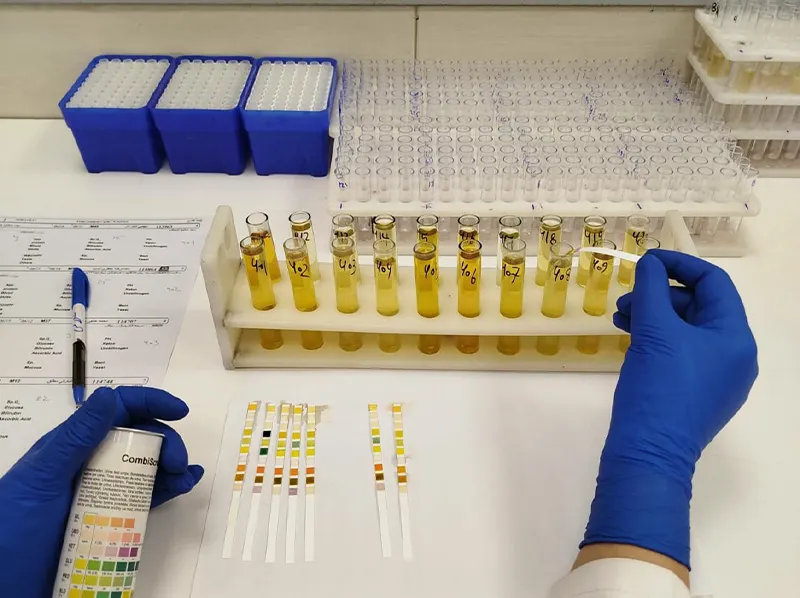
Chemical analysis is usually performed using appropriate laboratory methods and reagent strips and may include assessment of:
Protein
Glucose
Ketones
Blood
Nitrite
Leukocyte esterase
Bilirubin
Urobilinogen
pH
Specific gravity
Abnormalities in any of these parameters should be interpreted together with other laboratory findings and the patient’s clinical condition. A single abnormal finding is usually not sufficient to establish a definitive diagnosis.
Microscopic Examination of Urine
Microscopic examination may assess the presence or quantity of various components in the urine sediment, including:
White blood cells (WBCs)
Red blood cells (RBCs)
Epithelial cells
Crystals
Urinary casts
Bacteria and certain microorganisms
Other elements present in the urine sediment
Microscopic findings should be interpreted in conjunction with the chemical examination, specimen quality, and the patient’s signs and symptoms.
When Is a Urinalysis Requested?
A physician may request a complete urinalysis in a variety of clinical situations, including:
General health assessment
Pain or burning during urination
Increased urinary frequency or urgency
Visible blood in the urine or an unusual change in urine color
Initial evaluation of certain kidney-related conditions
Evaluation of protein in the urine
Assessment of urinary glucose or ketones
Monitoring of certain chronic conditions
Pregnancy
Symptoms suggestive of a urinary tract infection
Evaluation before certain medical procedures or surgeries
Urinalysis is a supportive diagnostic test. Its results should be interpreted together with the patient’s medical history, symptoms, physical examination, and, when necessary, additional laboratory tests.
How Should a Urine Sample Be Collected?
The type of urine specimen required depends on the test ordered. For many routine urine tests, obtaining a clean and properly collected specimen is essential.
When a clean-catch midstream urine sample is requested, the patient is generally advised to:
Use a clean specimen container provided or recommended by the laboratory.
Clean the area around the urethral opening according to the instructions provided.
Allow the initial portion of the urine stream to pass into the toilet.
Without interrupting urination, collect the midstream portion in the specimen container.
Avoid touching the inside of the container or lid with the hands or other surfaces.
Deliver the specimen to the laboratory within the recommended time frame.
Collection procedures may differ for children, 24-hour urine specimens, urine cultures, and certain specialized tests. Instructions specific to the requested test should therefore be followed.
Why Is Urine Specimen Quality Important?
Specimen quality is one of the important factors affecting the reliability of urinalysis results.
Contamination with genital secretions, menstrual blood, or microorganisms from the skin may produce findings that do not necessarily reflect disease of the urinary tract.
In addition, prolonged delays in transporting or analyzing a urine sample may alter some of its physical, chemical, or microscopic characteristics.
For this reason, proper specimen collection is an integral part of the testing process, and following collection instructions can significantly contribute to obtaining reliable results.
Interpretation of Urinalysis Results
Findings such as WBCs, RBCs, protein, blood, nitrite, glucose, or ketones do not, by themselves, establish the presence of a specific disease.
For example:
The presence of bacteria may be associated with infection but may also result from specimen contamination.
Blood in the urine can have a variety of causes.
Urinary protein may increase transiently under certain conditions.
A negative nitrite result does not completely exclude a urinary tract infection.
Urinalysis results should therefore be interpreted in the context of the complete laboratory profile, specimen quality, clinical symptoms, and the physician’s assessment.
Parasitology and Stool Examination
Parasitology is a field of laboratory medicine concerned with the detection of disease-causing parasites or laboratory evidence associated with parasitic infections in appropriate clinical specimens.
One of the commonly requested tests in this department is the Stool Ova and Parasite Examination (O&P), which is used to evaluate stool specimens for certain parasites and parasite-related structures.
Testing for hidden blood in stool may be performed using a Fecal Immunochemical Test (FIT).
Fecal Immunochemical Test (FIT) at Dr. Daneshbod Laboratory
At Dr. Daneshbod Laboratory, fecal occult blood testing is performed using a rapid immunochromatographic method, known as the Fecal Immunochemical Test (FIT).
FIT is designed to detect human hemoglobin in stool. Unlike older guaiac-based fecal occult blood tests, it generally does not require dietary restrictions because it is specific to human globin.
What Does a Stool Parasite Examination Detect?
During microscopic examination of a stool specimen, various structures associated with parasites may be evaluated, including:
Parasite eggs (ova)
Larvae of certain helminths
Cysts of intestinal protozoa
Trophozoites of certain protozoa
Oocysts of certain parasites
The structure that can be detected depends on the parasite involved and its stage in the life cycle.
Laboratory examination of stool may be used to investigate certain intestinal protozoa and parasitic worms (helminths).
When Is a Stool Parasite Test Requested?
A physician may request a stool examination for parasites when symptoms or medical history raise the possibility of a parasitic infection.
Situations that may warrant investigation include:
Persistent or recurrent diarrhea
Prolonged loose or watery stools
Abdominal pain or cramping
Persistent bloating or gastrointestinal symptoms
Unexplained weight loss
Certain travel histories or epidemiological exposures
Consumption of potentially contaminated food or water
Contact with an infected person in specific circumstances
Evaluation based on the physician’s clinical assessment
The presence of these symptoms does not necessarily indicate a parasitic infection, as many other gastrointestinal disorders can cause similar symptoms.
How Should a Stool Sample for Parasite Testing Be Collected?
Specimen quality is important for the laboratory detection of intestinal parasites.
For appropriate stool specimen collection:
Collect the specimen in a clean container intended for laboratory testing.
Do not mix the stool specimen with urine.
Avoid contact between the specimen and toilet water, soil, or cleaning agents.
Close the specimen container securely after collection.
Follow the laboratory’s instructions regarding transport time and storage conditions.
For certain tests, the type of preservative, transport time, and storage conditions may be particularly important. Instructions specific to the requested test should therefore be followed carefully.
Does a Negative Stool Sample Rule Out Parasitic Infection?
No.
Some parasites or particular stages of their life cycles may not be continuously present or detectable in every stool specimen. Therefore, a single negative result does not always definitively exclude a parasitic infection.
If clinical suspicion remains, the physician may request stool specimens collected on separate days or recommend a different laboratory method.
The number of specimens required should be determined according to the physician’s request and laboratory instructions.
Are All Intestinal Parasites Detected Using the Same Method?
No. The appropriate laboratory method depends on the suspected parasite and the purpose of the investigation.
Depending on the clinical situation, laboratory evaluation for intestinal parasites may include:
Direct microscopic examination
Stool concentration techniques
Special staining methods
Antigen detection assays for certain parasites
Molecular methods in selected cases
No single method is equally suitable for detecting all parasites. The test method should therefore be selected according to the suspected organism and the diagnostic objective.
A negative stool parasite examination does not mean that a stool culture is negative, and vice versa, because these tests are designed to investigate different types of infectious agents.
The physician determines which laboratory investigation is appropriate based on the patient’s symptoms, medical history, and differential diagnosis.
Urine and Stool Parasite Testing at Dr. Daneshbod Laboratory in Shiraz
At the Urinalysis and Parasitology Department of Dr. Daneshbod Pathobiology Laboratory in Shiraz, complete urinalysis, microscopic urine examination, stool examination for parasites, and FIT testing for occult blood in stool are performed according to the physician’s request.
Correct specimen collection and timely transportation are important parts of the testing process. If you have questions regarding the appropriate specimen container, urine or stool collection procedure, recommended delivery time, or specific test requirements, it is advisable to obtain the relevant laboratory instructions before collecting the specimen.
For specimen collection guidance and information about laboratory admission and testing, you may contact Dr. Daneshbod Laboratory in Shiraz.
Frequently Asked Questions About Urinalysis and Stool Parasite Testing
What Does a Complete Urinalysis Show?
A complete urinalysis includes physical, chemical, and microscopic examination of the urine and may provide information about blood, protein, glucose, ketones, RBCs, WBCs, crystals, and other urinary findings.
The results should be interpreted together with the patient’s symptoms and other relevant medical findings.
Can a Complete Urinalysis Diagnose a Urinary Tract Infection?
Urinalysis may show findings such as increased WBCs, positive nitrite or leukocyte esterase, and the presence of bacteria, which can increase the likelihood of a urinary tract infection.
However, urinalysis alone is not always sufficient to confirm or exclude a urinary tract infection.
Specimen quality, epithelial cell count, antibiotic use, the type of microorganism, and the patient’s symptoms may all influence interpretation. When identification of the causative organism and assessment of antimicrobial susceptibility are required, the physician may request a urine culture and antimicrobial susceptibility test.
Does the Presence of Bacteria in Urine Always Mean Infection?
No. Bacteria in a urine specimen may be associated with infection, but specimen contamination is another possible explanation.
WBCs, nitrite, leukocyte esterase, epithelial cells, clinical symptoms, and, when appropriate, urine culture results should be considered together.
What Is the Difference Between Urinalysis and Urine Culture?
Urinalysis evaluates the physical, chemical, and microscopic characteristics of urine.
A urine culture, on the other hand, is performed to detect the growth of culturable bacteria or other microorganisms and, when appropriate, to determine their antimicrobial susceptibility.
Do I Need to Fast Before a Urinalysis?
Fasting is generally not required for a routine urinalysis alone.
However, if other tests—such as certain blood tests—have been ordered at the same time, fasting may be required for those tests. The physician’s order and laboratory instructions should be followed.
What Is the Difference Between a Stool Parasite Examination and a Stool Culture?
These tests have different diagnostic purposes.
A stool parasite examination is performed to detect parasites or parasite-related structures, whereas a stool culture is generally used to investigate certain pathogenic bacteria and is part of microbiological testing.
Do I Need to Fast Before a Stool or Parasite Test?
Fasting is generally not required for routine stool parasite testing.
However, requirements may vary depending on the specific test ordered, so the instructions provided by the laboratory should be followed.
Does a Negative Stool Parasite Test Mean That No Intestinal Parasite Is Present?
Not necessarily.
Some parasites or parasite-related structures may be shed intermittently, and the sensitivity of different laboratory methods also varies.
If clinical suspicion persists, the physician may request additional stool specimens or another laboratory method.
How Many Stool Samples Are Required for Parasite Testing?
The number of specimens required depends on the patient’s condition, the suspected parasite, and the physician’s request.
In some situations, examination of specimens collected on separate days may be recommended to improve the likelihood of detecting a parasite. The final number of samples should be determined according to the physician’s request and laboratory instructions.
Are Urinalysis and Stool Parasite Tests Available at Dr. Daneshbod Laboratory in Shiraz?
Yes. The Urinalysis and Parasitology Department at Dr. Daneshbod Laboratory in Shiraz performs complete urinalysis, stool examinations for parasites, and FIT testing for fecal occult blood according to the physician’s request.
Summary
The Urinalysis and Parasitology Department at Dr. Daneshbod Laboratory in Shiraz covers two important areas of medical laboratory testing.
Physical, chemical, and microscopic examination of urine can provide useful preliminary information about the urinary tract, kidneys, and certain metabolic conditions.
In the parasitology section, stool examination using methods appropriate to the suspected organism can assist in the laboratory diagnosis of certain intestinal parasitic infections, while FIT can be used to detect occult blood in stool.
For both urine and stool testing, specimen quality, proper collection and transportation, the laboratory method used, the patient’s clinical condition, and physician interpretation are important for accurate assessment of the results.